
INTRODUCTION
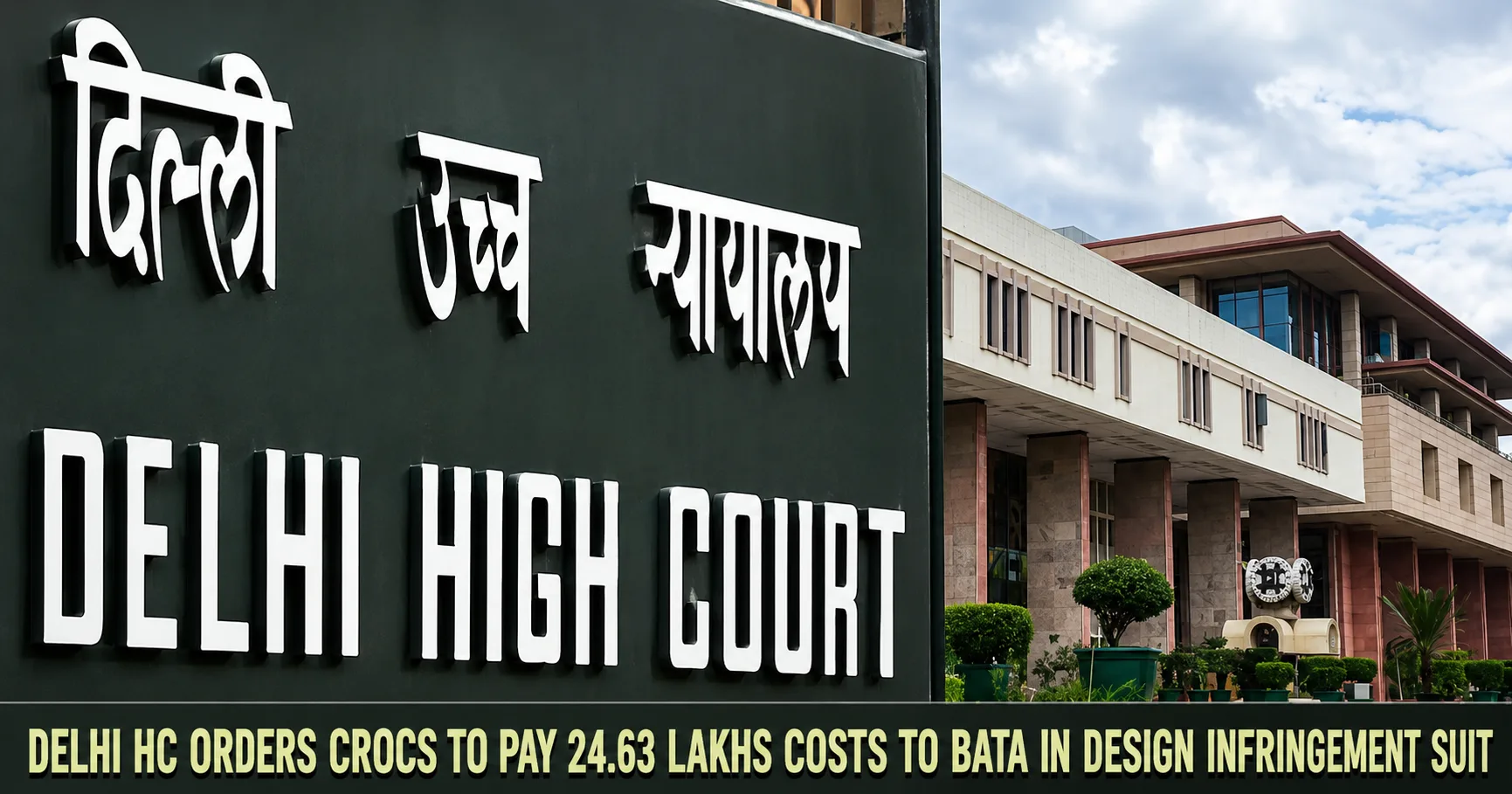
Intellectual Property Litigation often extends beyond questions of infringement. The dispute between Crocs and Bata which began with a design infringement, ultimately evolved into an important lesson on the consequences of unsuccessful litigation. On July 2, 2026, the Delhi High Court, in Crocs Inc. USA v. Bata India Ltd. & Ors., delivered an important decision on the award of litigation costs in commercial intellectual property disputes. The controversy originally arose from allegations of design infringement relating to Crocs’ iconic clog footwear and the Court was ultimately called upon to decide whether Bata India Ltd. was entitled to recover the legal expenses it had incurred over more than a decade of litigation.
BACKGROUND
Crocs Inc. instituted the suit back in 2014 alleging that Bata had infringed its Registered Design No. 197685 relating to the distinctive and unique shape of its well-known clog footwear. Initially, the District Court granted an ex-parte ad-interim injunction in favour of Crocs and appointed Local Commissioners to inspect Bata’s premises which resulted in the seizure of Bata’s products. This order significantly affected Bata’s commercial operations.
CHALLENGE TO THE DESIGN
Upon entering appearance, Bata contested the validity of Crocs’ registered design for the Clog footwear. Bata contended that the design lacked novelty and originality, asserting that it had been in the public domain by prior publications and existing footwear designs.
The Single Bench of the Delhi High Court considered these objections while deciding whether the interim injunction should continue and in February 2018, dismissed Crocs’ plea for interim injunction after concluding that the design lacked novelty and that the footwear had previously existed in the public domain. As a result, the interim injunction was vacated, permitting Bata to continue manufacturing and selling the impugned footwear products. The Hon’ble Court also awarded actual costs incurred by the Defendants, alongwith a sum of INR 2 lakhs.
Thereafter, Crocs challenged this order before the Division Bench of the Delhi High Court and subsequently before the Supreme Court of India. However, the appellate proceedings did not alter the order vacating the interim injunction. The Supreme Court directed Crocs to comply with the interim costs awarded while also clarifying that the ultimate liability for costs would depend upon the final outcome of the suit.
CANCELLATION OF THE REGISTERED DESIGN IN THE INTERIM
The dispute took a major turn in 2019 when separate cancellation proceedings concerning Crocs’ Design Registration No. 197685 were initiated before the Controller of Designs by M/s Brainbees Solutions Pvt. Ltd.
The Controller cancelled the design registration after concluding that the registered design lacked novelty and had been previously published in the market. The cancellation substantially weakened Crocs’ ability to maintain an infringement suit based on the design registration.
Subsequently, the Delhi High Court observed that the design registration had not only been cancelled but had also expired during the pendency of the proceedings. Consequently, in July 2023, the Delhi High Court disposed of the suit, stating that there was no longer any enforceable registered design capable of supporting the infringement action. However, the Court clarified that Crocs would remain free to pursue remedies should the cancellation order be reversed in appeal.
APPLICATION FOR LITIGATION COSTS
Following the disposal of the suit, Bata filed an application under Sections 35 and 35A of the Code of Civil Procedure,1908, seeking recovery of litigation expenses incurred over the course of the proceedings.
Bata submitted a detailed statement of costs supported by affidavits and documentary evidence.
The total amount claimed was ₹24,63,400.
Now, the principal issue before the Court was whether Crocs should compensate Bata for the cost incurred for litigation that ultimately failed.
DECISION OF THE COURT
Justice Pratibha M. Singh answered in the affirmative.
The Court observed that the litigation had continued for more than a decade requiring Bata to defend itself before various judicial forums, including the District Court, Delhi High Court, Division Bench of the Delhi High Court, Controller of Designs and lastly, the Supreme Court of India. Moreover, during the whole duration of the proceedings, Bata had also been aggrieved by the ex-parte ad-interim injunction order.
The Court further noted that repeated judicial findings had concluded that the registered design of Crocs lacked novelty and was cancelled eventually. Since, Bata had ultimately succeeded in defending against the infringement litigation, the principles governing commercial disputes required that it be compensated for the actual costs incurred. Accordingly, the Court directed Crocs to pay ₹24,63,400 to Bata within three months.
CONCLUSION
The Crocs Inc. USA v. Bata India Ltd. & Ors. litigation demonstrates that the success of a design infringement action is fundamentally dependent upon the validity and enforceability of the underlying design registration. A registered design that lacks novelty or originality cannot serve as a sustainable basis for enforcing exclusive rights, regardless of its commercial popularity or market recognition. The cancellation of Crocs’ design registration effectively brought its infringement claim to an end, demonstrating the significant role that validity plays in design protection under Indian law.
Moreover, by awarding Bata the full litigation costs incurred for over more than a decade, the Delhi High Court reaffirmed the principle that a successful party in commercial disputes should ordinarily be compensated for the reasonable expenses of defending the proceedings.
Author:
Mrs. Diksha Singh,
Managing Associate