
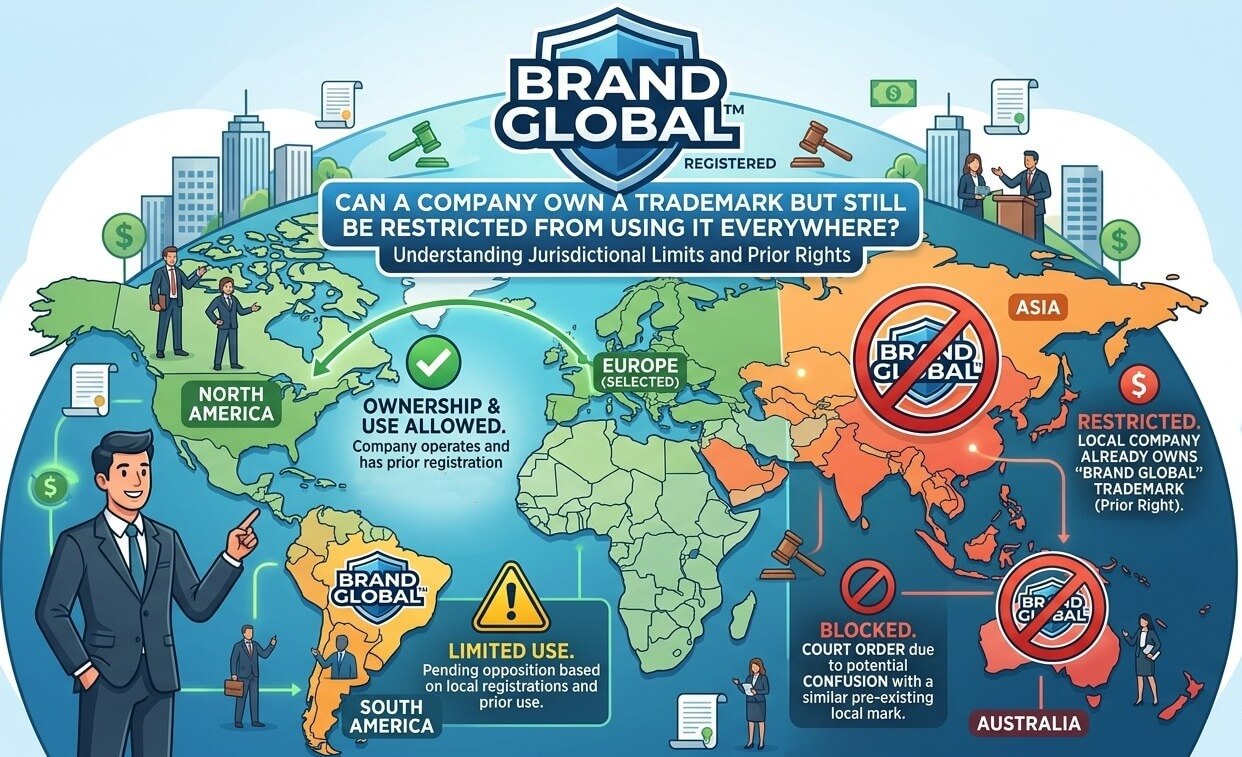
Can a company own a trademark but still be restricted from using it everywhere?
The Paradox of Trademark Ownership
Trademark ownership is often viewed as the ultimate badge of brand control. Businesses invest significant time and resources in developing distinctive brands, securing registrations, and building consumer recognition around their trademarks. It is therefore easy to assume that once a company owns a trademark, it enjoys an unrestricted right to use that mark wherever and however it chooses.
The reality, however, is far more nuanced.
Trademark Ownership Does Not Guarantee Unrestricted Use. For example, a company may own a trademark and still encounter restrictions arising from territorial boundaries, prior user rights, statutory defences, licensing arrangements, co-existence agreements, goodwill considerations, and judicial scrutiny of the relationship between ownership and commercial use.
Territorial Boundaries: Why Trademark Rights Stop at National Borders
One of the most common situations in which a trademark owner may be restricted from using its own mark arises from the territorial nature of trademark rights.
Unlike many other forms of intellectual property, trademark rights are fundamentally territorial in nature. A registration obtained in India protects the mark within India. It does not automatically confer corresponding rights in the United States, China, Australia, the European Union, or any other jurisdiction.
This principle has resulted in numerous disputes involving internationally recognised brands. One of the most cited example is the case of BURGER KING where despite owning the famous BURGER KING trademark globally, the company could not operate under that name in Australia because another entity had acquired rights to the mark. As a result, Burger King entered the Australian market under the name “Hungry Jack’s”.
Similarly, several multinational corporations entering China have encountered trademark squatters who registered identical or similar marks before the arrival of the genuine brand owner. These examples illustrate a fundamental reality: ownership of a trademark in one country does not necessarily guarantee freedom to use it everywhere.
Also, in India in the recent case of The Indian Express (P) Ltd. v. Express Publications (Madurai) Pvt. Ltd., the Bombay High Court upheld an order restraining The New Indian Express, from operating the brand outside its contractually permitted territories, affirming a prior ruling in favour of The Indian Express.
When Registration Gives Way to Prior Rights
A company’s trademark rights may also be restricted by the existence of prior users.
Section 34 of the Trade Marks Act preserves the rights of a prior user even against a registered proprietor. The principle has repeatedly been affirmed by Indian courts, most notably by the Supreme Court in S. Syed Mohideen v. P. Sulochana Bai, where the Court observed that priority in adoption and use prevails over priority in registration.
This implies that a company may hold a valid trademark registration and yet find itself unable to restrain another party that can demonstrate earlier and continuous use of the mark. The law recognises that trademarks derive their value from reputation and goodwill generated in the marketplace.
The Challenge of Trademark Holding Companies: Ownership Without Use
Modern businesses increasingly separate intellectual property ownership from business operations through Trademark Holding Companies or Intellectual Property Holding Companies (IPHCs). These entities are established to own trademarks while licensing them to operating subsidiaries.
From a commercial perspective, such structures offer several advantages, including centralised brand management, licensing flexibility, asset protection, and simplified monetisation of intellectual property. However, they also expose an important legal question: can a company that merely owns a trademark, but does not itself use it, continue to enjoy the full benefit of trademark protection?
Indian trademark law permits such arrangements, but only subject to certain safeguards.
Section 2(1)(v) of the Trade Marks Act defines a proprietor as a person claiming to be the owner of a trademark used or proposed to be used by him. Further, Sections 48 and 49 recognise the concept of permitted users, allowing use of a trademark by entities other than the registered proprietor.
However, ownership alone is insufficient.
In Hardie Trading Ltd. v. Addisons Paints & Chemicals Ltd., the Supreme Court emphasised that the essence of trademark ownership lies in control. The Court observed that a proprietor who permits uncontrolled use of a trademark by another entity risks losing the distinctiveness associated with the mark. Thus, even where a holding company owns a trademark, it must continue to exercise effective supervision over its use by subsidiaries and licensees.
A company may therefore own a trademark but still be restricted in how it uses, licenses, or enforces that trademark if it cannot demonstrate genuine control over the goodwill associated with the mark.
Statutory Defences Can Override Trademark Exclusivity
The Trade Marks Act itself contains several provisions that limit the exclusivity enjoyed by a registered proprietor.
A notable example is Section 35, which protects the bona fide use of a person’s own name.
The recent decision of the Bombay High Court in Kataria Insurance Brokers Pvt. Ltd. v. Bhavesh Suresh Kataria 2026 SCC OnLine Bom 1771, decided on 23-2-2026 illustrates the significance of this provision. The respondent, who owned registered trademarks for “Kataria” in Class 36, sought to restrain the appellant from using the same name in connection with insurance services.
The Division Bench, however, held that the appellant’s use of the surname “Kataria” was bona fide, continuous, and rooted in a long-standing family business identity. Significantly, the Court rejected the argument that Section 35 is confined only to natural persons and held that companies could also avail the benefit of the provision.
The judgment demonstrates that even a registered trademark owner may be unable to prevent certain uses of a mark where statutory protections intervene. Ownership, therefore, does not always translate into absolute control.
Conclusion
The assumption that a trademark owner is entitled to use its mark everywhere remains one of the most enduring misconceptions in intellectual property law. While registration grants exclusivity, the extent of that exclusivity is shaped by a complex framework of territorial rights, commercial realities, and competing legal interests. Trademark ownership undoubtedly remains one of the most valuable rights available to a business. However, it is not an absolute right. The emphasis is no longer merely on who owns the trademark, but on how it is used, controlled, and perceived by consumers.
A company may therefore own a trademark and still be restricted from using it everywhere. Ultimately, trademark law protects not merely ownership, but the integrity, distinctiveness, and goodwill that a trademark represents in the marketplace. Ownership may open the door to protection, but it does not eliminate every legal limitation on the use of a mark.
Author:
Mr. Amit Mahajan
Associate Partner – Trademarks
Co-Author:
Mr. Prateek Dhingra
Principal Associate – Trademarks